


This piece originally ran in Essense of Baseball on June 6, 2011.
The Highs and Lows of Tim Wakefield
(Editor’s Note: Since I was asked to contribute to Pedro Martinez Week at Saves and Shutouts, I demanded that Nick Tavares return the favor and write something for this site as well. Not only will you enjoy this contribution, you should check out his site–as his detail and story-telling are top notch).
* * *
Just as quickly as Daisuke Matsuzaka seemed to show promise in 2011, he’s off the active roster.
Matsuzaka has made seven starts this season, striking out 26, walking almost as many, and earning a 5.30 ERA along the way. Not the worst, not the best, but certainly worthy of a spot in a major league rotation. Look at your average no. 5 starter, and Matsuzaka is better than that average, bottom tier it may be. Through that small sample, pitched as well and as poorly as a pitcher can start.
But he’s out of commission for the time being, and with reports of Tommy John surgery on the horizon, he’ll be a ghost on the Red Sox payroll for the next 12 months.
Enter Tim Wakefield.
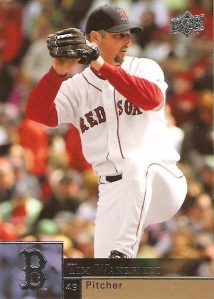 Though just as spastic on the scale, Wakefield has been far less maddening to watch through his career than the star-crossed Japanese ace. For one, the expectations have never been too high for Wakefield. With Pittsburgh, he was a converted first baseman not expected to make a dent in the majors, never mind the glorious splash of his rookie season.
But that didn’t last, Wakefield lost his touch on the knuckleball, and he was back in the minors, pitching in Buffalo, N.Y., miles away from the majors.
If you’re reading this, you know the rest. Plucked off the scrap heap, control of the knuckleball regained, he’s been in Boston since 1995. He’s won 195 games in the major leagues, and he has been called upon to win a few more with the Sox’ rotation in a situation.
There seems to be a small movement, or popular belief, that if Tim Wakefield isn’t done, he’s about to be. For the past two seasons, he’s had to fight and wait for just such a spot in the rotation, while fans and pundits alike weigh the relative worth of young or unproven pitchers — Felix Dubront, Alfredo Aceves, Michael Bowdon — in that slot.
As a fan, it’s impressive enough that Tim Wakefield has dedicated his life to a pitch that seems just as likely to leave a future Hall of Famer in a stupor as it is to hang over the top of the plate, waiting to be rejected over the wall. There are times when he dazzles, and there are times when he’s shelled. It’s the life chosen when a career hangs on the knuckleball. It takes a special, steely resolve to keep the highs and lows in balance.
Starting in Matsuzaka’s place, Wakefield won his first two starts easily. He pitched into the seventh in both games, limited the Cubs and Tigers to one and two runs, respectively, and eased a lot of pressure off the rest of the pitching staff, bullpen and rotation alike. Even for his most ardent supporters, this was something of a surprise.
On Wednesday afternoon, Tim Wakefield pitched well. According to the box score, he hung in there for six innings against the White Sox, giving up four runs, controlled his floater for one walk, and left Boston in a position to win.
But beyond the box score, Wakefield’s lead by a comedy of errors in the field. Wakefield cruised through his first four innings, but in the fifth, Dustin Pedroia couldn’t come up with a fly ball between himself, Adrian Gonzalez and rightfielder Josh Reddick. Pedroia then threw a potential double-play ball wide to Gonzalez at first, keeping a runner on. A bad call allowed Juan Pierre to steal second base instead of being called out. Catcher Jarrod Saltalamacchia broke the wrong way on a popup behind the plate, missing out on an easy out.
The White Sox scored two runs that inning, and Brent Lillibridge tagged Wakefield for a solo home run, a toss that didn’t float the right way. After 98 pitches, Wakefield was done, leaving Boston with a 4-4 lead, with two of those runs being the least earned an earned run could be. Matt Albers settled the matter once and for all, giving up what turned out to be the winning run to Chicago the next inning.
The Red Sox lost, 7-4, and Wakefield remained at 195 wins. So it goes for the 44-year-old knuckleballer.